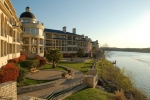
In 1906, Judge Robert Batts built a rustic stone house on a hill overlooking the Colorado River, west of Austin. He was not alone. Lots of people constructed homes of stone or wood in the area, several miles outside of town.
"The area was particularly popular, apparently, during prohibition because it was a long way from the arm of the law and lobbyists could party out here without being observed too closely," said architectural historian Peter Flagg Maxson.
Maxson is on the board of the Heritage Society of Austin, which will stage it's eighteenth annual homes tour this Saturday. Billed as the "Livin' in River City" tour , it will feature six homes in the same neighborhood as the Batts property. The common denominator, he points out, was not so much a haven for hard drinking lobbyists, as it was a respite from the summer heat in the days before air conditioning. You see, the structures were built on a hill overlooking a stretch of the Colorado River that today is known as Lake Austin.
"The lake breezes, being on a raised position," he said, "worked pretty well in keeping people a lot cooler than they would have been if they'd been on a small flat lot in the city."
The people then didn't just rely on the water for relief, however. Building techniques were important, as well.
The Batts house is owned today by architect Philip Hendren. He bought it back in 1969 just an hour after seeing it for the first time.
"There's an air space under the floor with vents from one end of the house all the way to the other end of the house on these battered stone supports," said Hendren. "And they've got grills in them, steel grills. So air can flow right through.
"One time, by accident, I knocked a hole in the middle of the wood floor and it was like turning the air conditioner on. When the air started coming up through that hole, I thought, my goodness, I didn't realize how effective that idea is.
"It also had turbine vents on the roof to get hot air out and then the insulation value of a fifteen-inch stone wall with an air space is very high. So it just had fundamental things which are very important and they don't do them anymore. Now we overpower with air conditioning, but this had a lot of natural features. There's something about stones that just kind of cool, anyway.
"Now all the houses on the tour are part of Tarrytown, one of Austin's most desirable and expensive neighborhoods. Some residents in the area are restoring their homes, but others are tempted by visions of newer, bigger and better.
"People will look at a nice, medium-sized 1930s house and think that a McMansion sure would look good on that same site," said Maxson.
The resulting preservation issues are behind the Heritage Society's decision to focus on the neighborhood for its annual tour, which is scheduled for Saturday from 10:00 a.m to 4:00 p.m.